Maths where the game is the maths
Numberkit is a maths app for children of about 7 to 11, and for anyone learning these ideas. Children learn by building numbers, and every idea is taught on a picture before it is practised. A child moves on when they are ready, not when their year says so.
Today it covers times tables and division facts, place value, and written methods for adding, subtracting, multiplying, and dividing big numbers.
Ask for an invite
Numberkit is invite-only while it is tested with a small number of families.
Your address is used only to send you an invite. If no invite is sent, it is deleted after 90 days.
What makes it different
Numbers you build
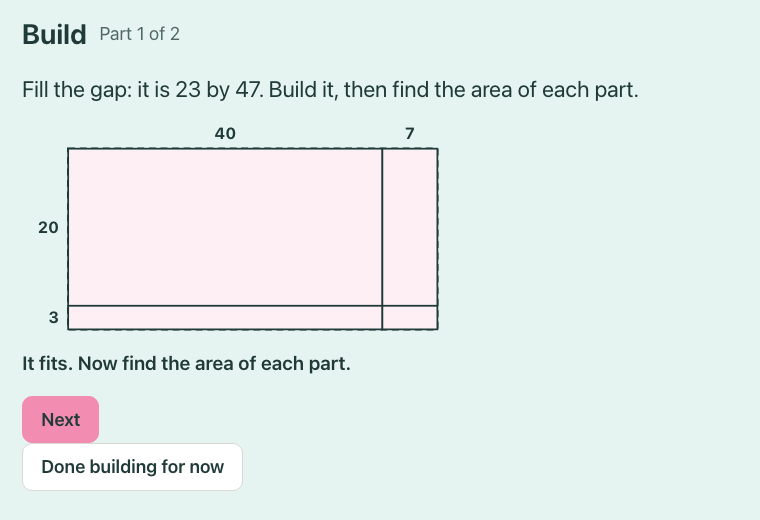
In most maths apps the fun is a costume over a quiz. Here the numbers are the things you play with. A gap 23 by 47 only fits a 23 by 47 rectangle, and a wrong size visibly does not fit.
Taught before it is practised
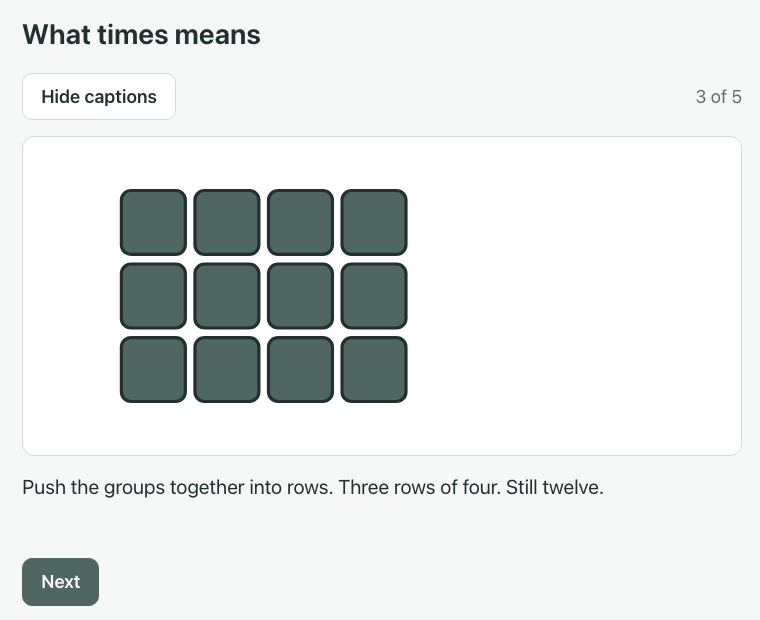
Every new idea starts on a picture, such as groups pushed together into rows, with the words spoken aloud. Practice then moves to plain numbers. In fact practice, a wrong answer is followed by the way to work it out.
Facts that belong together
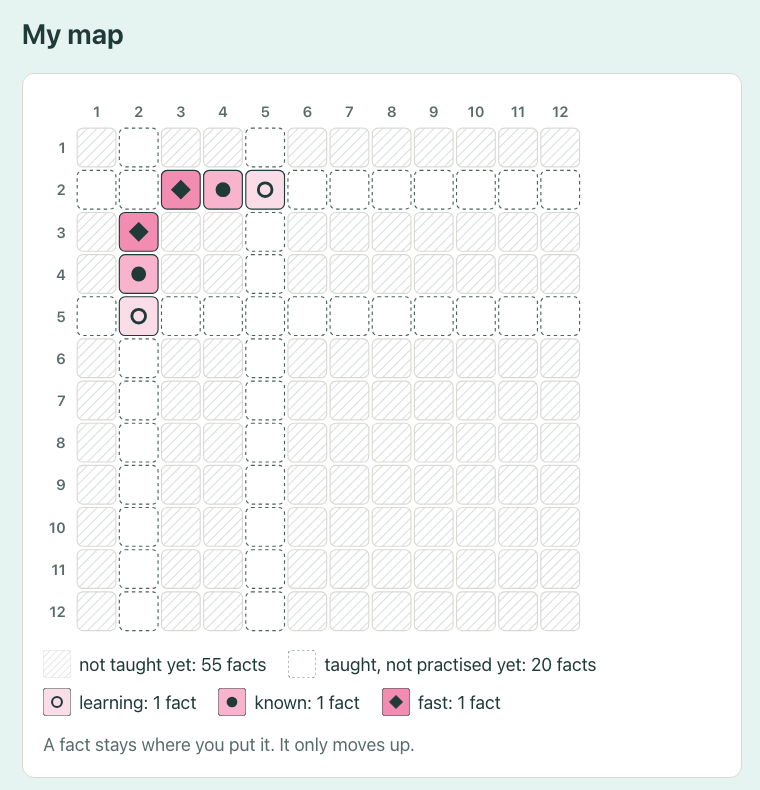
7 × 8, 8 × 7, 56 ÷ 7, and 56 ÷ 8 are one family, learned as one. Facts are worked out from ones already known, then practised a little each day, spaced out and mixed up, until they are instant.
Speed without a stopwatch
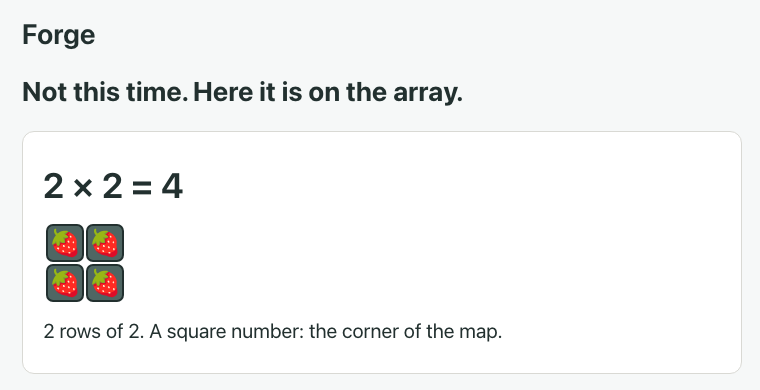
The app notes how long each answer takes, silently, and practice has no countdown. The only clocks a child sees are a one-minute check at the start and once a week, framed as a look at how they are getting on, and sprints they choose, which give a count but no feedback on each question. In fact practice, a wrong answer is followed by the way to work it out, and the child types the right answer back once. Straight after a lesson, that waits until the end of the set.
One child, not a year group
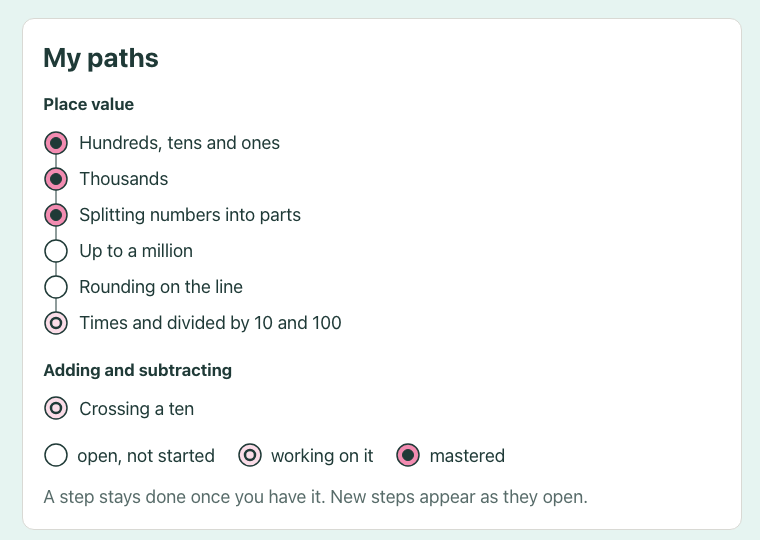
Nothing opens by age or year. A new step opens when the steps under it are mastered, so a child can race ahead in one area and take longer in another. Parents see what was learned and how it is coming along, never a comparison with other children.
What it does not do
- No countdown timers in practice.
- No coins, shops, leaderboards, or badges for playing longer.
- No ads, no trackers, and no third-party scripts.
- Your data is never sold.
Built on the research
The design is built on peer-reviewed studies and national practice guides. Where the evidence is thin, or a number is a starting value still to be tuned, the plan says so. The reviews set it out:
- How 9-year-olds become fluent in math facts, and how to practice without inducing math anxiety
- Teaching Math Concepts to 9-Year-Olds with Visual Models, Animation and Explanation: Evidence Review
- Making a Math App Genuinely Fun for a 9-Year-Old: Literature Review
- Adaptive Learning, Mastery, Knowledge Tracing and Feedback for a Solo-Built Math App (age 9)
- Competitive Landscape: Math Learning Apps for Ages 8-11 (Grades 3-5)
- Attention, ADHD, and math practice: what the evidence says for a fluency and learning app
- General learning science for Numberkit (how people learn and remember, beyond games and apps)
- How people learn mathematics: evidence from cognition and classrooms, and what an app can take from it
- What Effective Human Teaching and Tutoring Do, and What an App Can Take From Them
- Motivation, Emotion, and Habits in Learning Mathematics
- Calibrating and evaluating Numberkit with very few learners
For parents and schools
- A child's profile holds a first name or nickname, a school year, a picture PIN, and their progress. A parent can also add names of family, friends, or pets to appear in word problems. No date of birth, no email address, and nothing a child types freely.
- Parents can download everything their family has stored, and delete it. Deleted data is erased at the nightly clean-up 30 days after the request, and is gone from the database's short-term backups within a day after that.
- Numberkit runs on Vercel and keeps its data with Neon, both in London. Sign-in email goes through Resend, in Ireland. No one else receives your data.
- An address left in the invite box is used only to send an invite. It is deleted after 90 days if no invite is sent.
Ask for an invite
Your address is used only to send you an invite. If no invite is sent, it is deleted after 90 days.